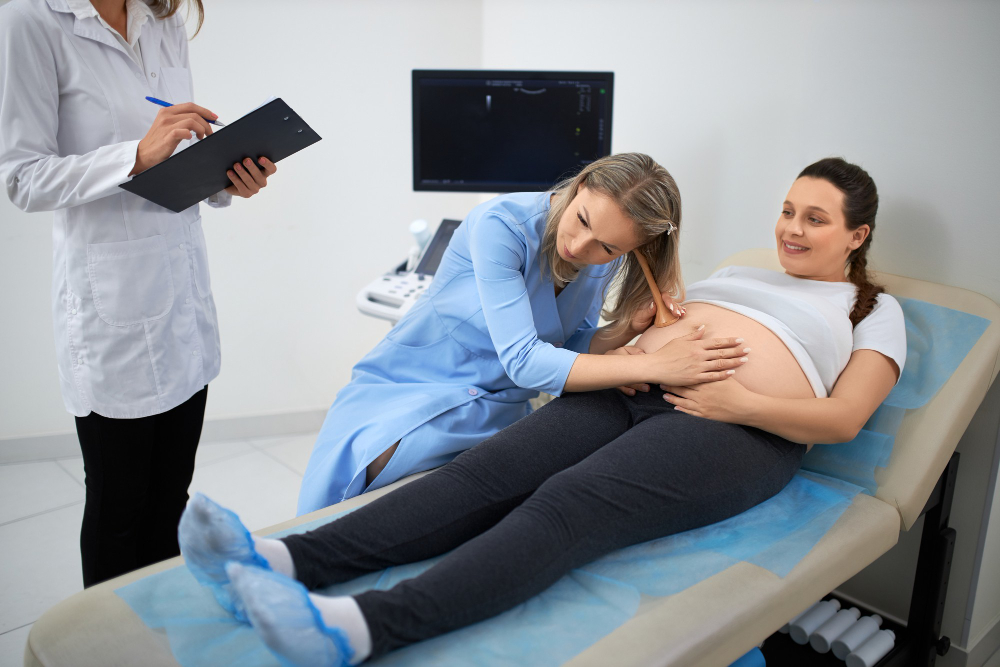
An ectopic pregnancy is a critical, life-threatening gynecological complication that occurs when a fertilized egg (embryo) implants and begins to grow outside the primary endometrial cavity of the uterus. More than 95% of all ectopic pregnancies are localized within the fallop tubes (tubal pregnancy); however, they can rarely implant on the ovaries, within the abdominal cavity, or along a past cesarean scar line (scar pregnancy) from a gynecological standpoint. Because these exterior anatomical areas lack the vascular expansion and muscular architecture required to sustain fetal development, it is medically impossible for an ectopic pregnancy to progress to a healthy full-term birth. If left undetected, the rapidly expanding embryo will eventually rupture the hosting tissue, particularly the fallopian tube, inducing severe life-threatening internal pelvic hemorrhage. Consequently, early gynecological scanning and diagnosis are paramount both to save the patient’s life and to protect her future reproductive capacity (fertility).
Initially, an ectopic pregnancy mimics the markers of a standard healthy gestation, presenting with missed periods, early morning nausea, and positive urinary or serum pregnancy test indications. However, as the gestation expands gynecologically and stretches the fallopian tube, the clinical manifestation shifts drastically:
-
Clinical Symptoms: Patients experience sudden, sharp, stabbing, or knife-like localized pains on one side of the lower abdomen or pelvis, accompanied by irregular vaginal bleeding or dark, mud-colored gynecological spotting. If internal bleeding occurs and irritates the phrenic nerve near the diaphragm, referred pain in the shoulders and neck manifests, alongside dizziness, fainting spells, blurred vision, and cold sweats—all of which serve as immediate warnings for urgent gynecological surgery.
-
Diagnostic Mapping: In our clinic, patients suspected of an ectopic pregnancy undergo quantitative tracking of serum Beta-hCG (pregnancy hormone) levels at 48-hour intervals. While a healthy intra-uterine pregnancy exhibits at least a 60% exponential rise, a plateauing or fluctuating pattern coupled with high-resolution transvaginal ultrasonography (USG) that reveals an empty uterine cavity alongside a suspicious adnexal mass establishes a definitive diagnosis.
The definitive treatment roadmap—whether medical or surgical—is meticulously devised by Op. Dr. Semra Capar, carefully adapted based on the gestational week, the numerical baseline of Beta-hCG, the presence of embryonic cardiac activity, and whether the fallopian tube remains unruptured. For early-stage, stable cases with low hormone markers and no internal fluid collection, a specialized non-surgical chemotherapy agent called "Methotrexate" is utilized (medical management). Administered via single or multiple intramuscular injections, this formula targets and halts the rapidly dividing embryonic cells from a gynecological standpoint, allowing the mass to be naturally absorbed by the body over time while keeping the fallopian tube completely free from surgical cuts. However, if the adnexal mass exceeds safe dimensions, if medical management fails, or if the fallopian tube is on the verge of tearing, minimally invasive "Laparoscopic Surgery" is the gold standard approach. Operating through millimetric ports in the abdominal wall using clear optical cameras, the gynecologist can either safely slit the tube to express the pregnancy tissue while keeping the tube intact (salpingotomy) or completely excise the heavily compromised fallopian tube (salpingectomy) to ensure long-term stability. In acute emergencies where a tube has already burst and caused severe intra-abdominal shock, an emergency open laparotomy may still be deployed. Following either management pathway, close post-operative gynecological monitoring continues until Beta-hCG levels drop to zero, and total clinical and emotional counseling is provided to help patients cope with the pregnancy loss.
Frequently Asked Questions
-
What exactly is an ectopic pregnancy and why does it implant outside the uterus? An ectopic pregnancy occurs when a fertilized egg implants outside the uterine cavity, mostly within the fallopian tubes. It typically happens because chronic pelvic infections, tubal blockages, or poor tubal motility prevent the egg from completing its transit to the uterus.
-
Can a woman who has suffered an ectopic pregnancy conceive a healthy child in the future? Yes, the vast majority of women with a history of ectopic pregnancy can successfully achieve entirely healthy, standard pregnancies later on. However, having this condition once gynecologically elevates the risk of recurrence in subsequent gestations.
-
What are the primary medical risk factors associated with developing an ectopic pregnancy? Primary risk factors include a history of Pelvic Inflammatory Disease (PID) or tubal infections, prior ectopic events, previous fallopian tube reconstructive surgeries, smoking habits, advanced endometriosis, and assisted reproductive technologies like IVF.
-
How is the definitive diagnosis of an ectopic pregnancy verified in a clinical environment? Diagnosis is verified by demonstrating that serum Beta-hCG values are not doubling predictably every two days, coupled with transvaginal ultrasound imaging that shows an empty uterus despite elevated hormone parameters, or reveals an adnexal mass.
-
Can every patient presenting with an ectopic pregnancy be treated with Methotrexate injections? No, non-surgical medical treatment is strictly reserved for patients diagnosed early, whose fallopian tubes show no signs of rupture, who are hemodynamically stable with no internal bleeding, and whose initial Beta-hCG markers fall below specific medical margins.
-
How is a laparoscopic ectopic pregnancy surgery performed and what are its assets? Laparoscopy (closed surgery) is performed under general anesthesia through tiny millimetric port incisions made in the abdominal wall. Compared to open surgeries, it guarantees minimal physical pain, excellent aesthetic outcomes, and a significantly shorter gynecological recovery.
-
Is it always necessary to completely remove the fallopian tube during an ectopic surgery? Not necessarily. If the fallopian tube remains unruptured and has not sustained severe architectural destruction, the pregnancy tissue can be carefully cleared while preserving the tube. However, if massive tissue tearing or uncontrolled hemorrhage occurs, removal is safer.
-
How long does the gynecological recovery process take after medical or surgical intervention? With medication, clearing the hormone levels and absorbing the tissue requires a few weeks of clinical oversight. Following a closed laparoscopic intervention, patients are usually discharged within 1 day and resume normal routines within 1 to 2 weeks.
-
Do advanced In Vitro Fertilization (IVF) treatments increase the baseline risk for ectopic pregnancy? Even though embryos are placed directly inside the uterine cavity during IVF, uterine contractions or underlying tubal abnormalities can occasionally cause the embryo to migrate backward into the fallopian tubes, making the risk slightly higher than in natural conceptions.
-
Is there a definitive medical pathway to prevent or protect against an ectopic pregnancy? There is no pathway to guarantee 100% protection against an ectopic pregnancy. However, seeking early treatment for sexually transmitted infections, stopping smoking, and prioritizing early gynecological evaluation as soon as a period is missed significantly reduce severe complications.
To address your ectopic pregnancy concerns, explore our advanced diagnostics or state-of-the-art minimally invasive closed surgery solutions, and initiate a personalized gynecological care plan under the expert guidance of Op. Dr. Semra Capar, please contact our clinic today to schedule your appointment.